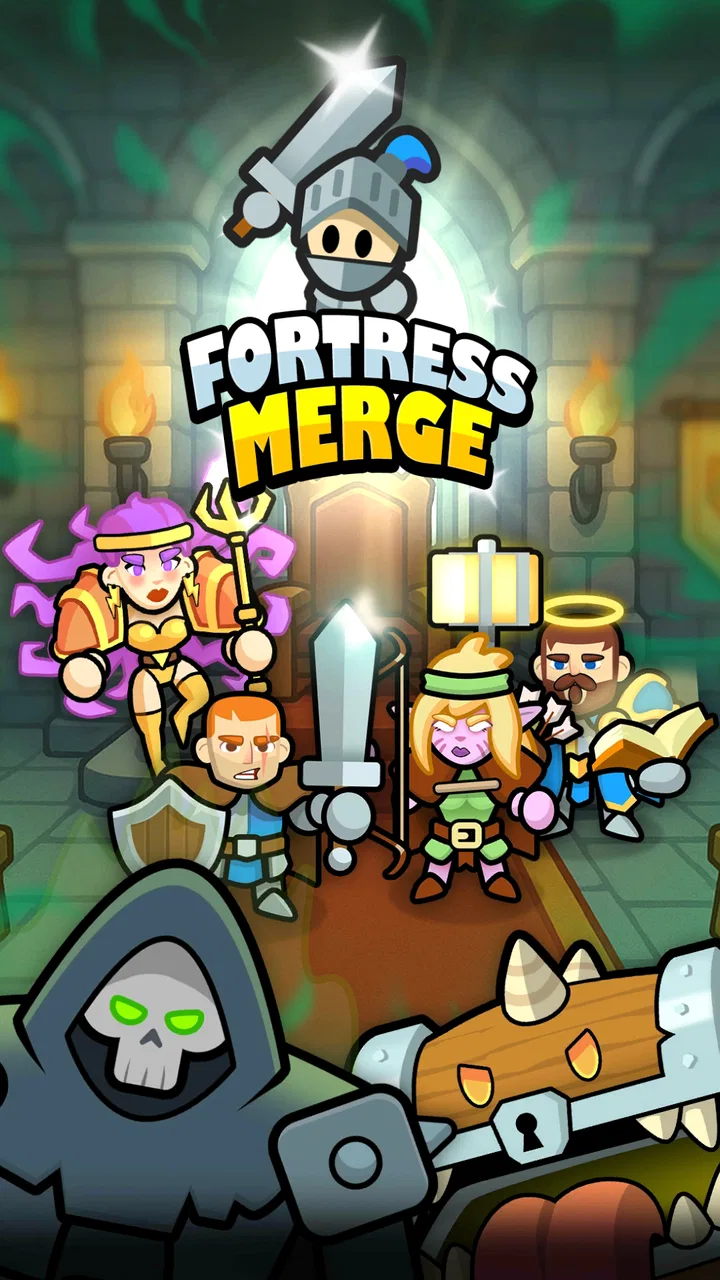
Fortress Merge: Puzzle Defense
- 4.3
- Rating
- 1.00M
- Installs
- Free
- Price

 Analysis by App-foxy
I went into Fortress Merge: Puzzle Defense expecting a light merge game with a defensive theme, and that is broadly what I found: short strategic sessions built around combining pieces, improving a city, and preparing for incoming enemy waves. The important difference is that the merging is not just a way to tidy up a board. It is tied to the question of what your city can survive next, so every upgrade feels connected to a practical defensive decision.
That makes it easy to understand in a few minutes, but not completely mindless. I can play a quick round while waiting for something, yet I still have to think about whether an immediate combination is better than holding pieces for a stronger improvement. TapNation keeps the presentation approachable, and the game is free to start, with optional purchases ranging from $0.99 to $109.99 per item. My overall impression is positive, especially for players who like puzzle progress with a little pressure, although people looking for a deep city simulation or a highly demanding strategy game may find it too streamlined.
How Fortress Merge turns simple goals into a playable routine
I find the most useful way to approach Fortress Merge is to treat each brief session as a chance to make one better decision, not simply to chase the next visible upgrade. That habit makes the game easier to share casually, because another player can pick up the same board and understand the immediate goal without needing a long handoff. It also leads naturally to a practical question for a shared device: what should each person keep in mind before taking a turn?
You May Also Like

 Blood Strike: 2.5 Anniversary
Blood Strike’s Loadouts Turn Every Drop Into a Tactical Gamble
A close look at Blood Strike’s custom loadouts: how fast access to signature weapons reshapes its battle royale rhythm, rewards preparation, and narrows the gap between fights.

 Pandora - Music & Podcasts
Pandora’s Music Is Easy to Start, but Harder to Recover
Pandora’s strength is its low-effort path from a seed to a station. Its weak spot is how much confidence it asks you to place in connection, setup, and quiet recovery.

 8 Ball Pool
 Is Built on Rivalries, Rematches, and Routine
A close look at the rivalries, rematches, shared routines, and unanswered safety questions that turn a quick pool match into a persistent mobile community.

 Samsung Music
’s Quiet Strength Is Playing What You Already Own
Its reach comes less from spectacle than from dependable access to a personal library. That simplicity is both the app’s strongest retention engine and its ceiling.

 AccuWeather: Weather Radar
AccuWeather Review: A Quick, Clear Forecast for Everyday Decisions
For everyday plans, the best forecast is the one you can understand quickly. AccuWeather makes rain timing, radar, and local conditions easy to act on, with a few trade-offs.

 Hill Climb Racing
Why Hill Climb Racing Still Turns Crashes Into One More Run
A tiny car, a bumpy hill and one more upgrade: Hill Climb Racing keeps resurfacing because its simple chaos makes every near-miss feel personal.
More From Our News Desk



The opening loop is clear without feeling empty
The first thing that works well is the clarity of the basic goal. I am not asked to learn a complicated economy, memorize a large set of unit abilities, or manage several unrelated menus before I can enjoy a session. The central routine is easy to grasp: merge useful pieces, strengthen the city, and face the next enemy wave. That sequence gives the game an immediate sense of purpose.
For a new player, this matters because the early objectives are visible through action rather than lengthy explanation. A merge produces a noticeable improvement, the city becomes more capable, and the upcoming defense gives that improvement a reason to exist. I never felt that I was collecting upgrades simply because a progress bar told me to. The defensive context gives each small step a job.
The early game is also a good test of whether this style suits you. If you enjoy watching a board become more efficient and like making modest improvements repeatedly, the opening hours are inviting. If you prefer a campaign with a strong story, character-driven missions, or a large tactical battlefield, the compact puzzle format may feel limited from the start.
Small decisions matter more than fast tapping
My most useful adjustment was to stop treating every available merge as automatically correct. Combining pieces quickly feels satisfying, but it can also remove flexibility from the board. I found myself getting better results when I paused to consider what the next defensive need might be instead of merging the first pair I noticed.
This is one of the less obvious strengths of the design. The game looks casual, yet the best move is not always the most immediate one. Saving a compatible piece, leaving room for a future combination, or choosing a practical improvement over a merely convenient one can make the following wave easier to handle. That gives the puzzle layer more weight than the bright, accessible presentation initially suggests.
My advice for new players is simple: use the first few sessions to learn the rhythm rather than chasing perfect efficiency. Notice which combinations leave you with useful options and which ones create a crowded or awkward board. That habit becomes more valuable than trying to play every turn as quickly as possible.
Progress feels tangible because the city is the reward
The city provides a useful visual and strategic anchor. Instead of feeling as though I am only upgrading abstract tiles, I can connect my actions to the place I am trying to protect. That relationship helps the game maintain momentum during quieter moments, when the puzzle itself is not especially surprising.
There is a satisfying contrast between construction and defense. Merging represents preparation; the enemy wave represents the test. When those two parts are balanced well, even a small improvement feels earned because I can immediately understand why it matters. This is more effective than a progression system that gives upgrades without asking the player to apply them.
At the same time, players should keep their expectations realistic. This is not a full city-builder in which I freely design roads, assign citizens, or shape a detailed urban economy. The city is part of the strategic puzzle framework, not a separate simulation game. That focused scope helps the sessions stay manageable, but it also means the building side will not satisfy someone who wants extensive customization.
How progress signals keep a session moving
Good casual strategy games need to show progress often enough that the player understands why another round is worthwhile. Fortress Merge does this through the relationship between merging, city improvement, and defense. I can see that a successful decision is moving me toward a stronger position, rather than merely filling an invisible meter.
That feedback is especially helpful on a phone. I do not need a long uninterrupted session to feel that I have accomplished something. A short play period can include a few meaningful combinations and a clearer idea of how to approach the next challenge. For commuters, students between tasks, or anyone who prefers games in small bursts, that structure is a natural fit.
One practical technique is to treat each session as a planning exercise rather than a race. Before the next wave, I look at the state of the city and ask what kind of improvement would actually help. This prevents the common mistake of pursuing the largest-looking merge while neglecting the upgrade that makes the defense more reliable.
Where the pacing succeeds
The pacing works best when the game alternates between calm preparation and a more urgent defensive moment. The preparation phase lets me experiment with combinations, while the approaching wave gives those choices a deadline. That contrast stops the merge board from becoming completely passive.
I also like that the game can be approached at two speeds. I can play casually, make obvious combinations, and still enjoy the visual sense of development. Or I can pay closer attention to board space and future options when I want more involvement. This flexibility is valuable because it lets the same game fit different moods.
However, the compact loop can become repetitive for players who need constant novelty. The core pleasure comes from improving decisions within the same basic framework, not from switching between many radically different game types. If your ideal strategy game continually introduces new factions, maps, or rules, this may feel restrained.
The difficulty curve rewards attention, not just persistence
The challenge is most interesting when the defensive waves expose weaknesses in the way I prepared. A weak result is not merely a failure screen; it can point to a planning problem. Perhaps I merged too freely, left the board without useful follow-up options, or focused on a visible improvement that did not solve the immediate threat.
That makes the difficulty feel more constructive than arbitrary. I can respond by changing my approach rather than simply repeating the same actions and hoping for a better result. The game is at its best when it asks me to understand the connection between board management and defense.
Still, the difficulty curve will not appeal equally to everyone. Players who want a highly punishing strategy experience may consider the decisions too accessible, while players who want a completely relaxing merge game may dislike the pressure of enemy waves. The game sits between those extremes, and that middle position is both its appeal and its main limitation.
What happens when the challenge starts to slow down
Progression games depend on a feeling that the next improvement is close enough to pursue. Fortress Merge benefits from that short-term motivation, but the same structure can create retention pressure. Once I understand the main loop, the question becomes whether the next city improvement or defensive milestone feels meaningfully different, rather than simply being another step along the same path.
This is where I recommend paying attention to your own habits. If you find yourself playing because each round is still presenting an interesting decision, the progression is doing its job. If you are playing only to get past a repeated obstacle or to reach the next reward, the loop may be losing its value for you.
The free entry point lowers the barrier to trying it, but optional purchases can change how some players experience the pacing. I prefer to approach the game first as a no-cost puzzle-defense title and decide later whether any purchase genuinely improves my enjoyment. There is no reason to spend simply because a harder wave has made the next step slower.
This is also why the game is not ideal for players who dislike any form of in-app purchase environment. Even when the core activity is enjoyable, the presence of optional items can make progression feel less purely skill-based to people who want a completely self-contained premium experience. A paid strategy game with a fixed price may be a better match for that audience.
Everyday use: a good fit for short attention windows
My most natural use case was playing in short gaps during the day. A few minutes were enough to review the board, make several merges, and think about the next defense. I did not need to remember a complicated narrative or reconstruct a large battlefield after putting the phone away. That makes the game comfortable for irregular play.
It also works well when I want a little more involvement than a pure idle game offers. I am not just waiting for resources to accumulate; I have to choose how to use the space and how to prepare. At the same time, it does not demand the sustained concentration of a long competitive match.
For families, the Everyone 10+ content rating makes it more approachable than many darker strategy games, though parents should still remember that the title includes optional in-app purchases. For younger players, the strategic value comes from planning and delayed gratification, but supervision around spending remains sensible.
How it compares with familiar alternatives
Compared with a traditional tower-defense game, Fortress Merge places more emphasis on preparation and combination than on manually positioning a large range of defenses. I spend less time adjusting a battlefield in real time and more time deciding how to turn available pieces into a stronger setup. Someone who loves detailed lane control may prefer a conventional tower-defense title.
Compared with a pure merge game, the enemy waves give the combinations a clearer consequence. A merge is not only a satisfying visual action; it is part of a plan for keeping the city standing. That added pressure makes the game more strategic, but it also removes some of the effortless calm that pure merge players may be seeking.
Compared with a full strategy or city-building game, this is much easier to pick up and play in short sessions. The trade-off is depth. I get a focused puzzle-defense loop instead of extensive diplomacy, resource chains, map exploration, or long-term urban planning. I would choose this when I want compact decision-making, not when I want a second job disguised as a game.
Device expectations and the practical download decision
The game is available as a free title for Android, with a minimum operating system requirement of Android 7.1. The current version is 0.4.6, and the developer is TapNation. Those details make it accessible to a broad range of Android users, including people who are not using the newest phone.
Its audience is already substantial, with over a million installs, and the game holds an average rating of 4.4 from around forty-four thousand ratings. That does not guarantee that every player will enjoy the pacing, but it does suggest that the basic merge-and-defense formula has found a sizeable audience.
I would recommend trying it if you want a free strategic puzzle that fits into short sessions, gives upgrades an obvious purpose, and offers more thought than a purely automatic progression game. I would skip it if you need deep city customization, a story campaign, highly complex tactical systems, or a completely purchase-free premium-style experience.
My verdict on goals, unlocks, and long-term pacing
Fortress Merge succeeds because its goals are easy to read: improve the city, prepare intelligently, and withstand the next wave. The progress signals are strongest when a merge clearly changes what I can defend, and the challenge is most satisfying when a setback teaches me to manage the board more carefully.
Its main weakness is that the same focused loop may eventually feel narrow. The game depends on the pleasure of refining decisions rather than constantly unveiling a huge number of new systems. That is a reasonable design choice for a mobile strategy puzzle, but it means long-term appeal will depend heavily on how much you enjoy repeating the cycle with greater awareness.
After spending time with it, I see it as a good middle ground between a relaxed merge title and a more demanding defense game. Its best quality is the way it turns small combinations into meaningful preparation. I would recommend giving it a fair trial, especially if you like games that can be played in short bursts but still reward patience, board awareness, and a willingness to think one move beyond the obvious merge.
FAQs for Fortress Merge: Puzzle Defense
01What is the main objective of Fortress Merge: Puzzle Defense?
Fortress Merge: Puzzle Defense combines elements of strategy and puzzle-solving. The primary goal is to merge identical units to strengthen your defenses against waves of enemies. Players must strategically place and upgrade their units to withstand increasingly difficult levels, making it a challenging yet rewarding experience.
02Is Fortress Merge: Puzzle Defense free to play?
Yes, Fortress Merge: Puzzle Defense is free to download and play. However, it includes in-app purchases that can enhance gameplay by providing additional resources, power-ups, or removing ads. These purchases are optional and not necessary to enjoy the full game experience.
03What are the system requirements for Fortress Merge: Puzzle Defense?
Fortress Merge: Puzzle Defense requires iOS 11.0 or later for iPhones, or Android 5.0 and up for Android devices. It is recommended to have a stable internet connection for downloading updates and accessing online features, although offline play is also supported.
04Can I play Fortress Merge: Puzzle Defense offline?
Yes, Fortress Merge: Puzzle Defense offers an offline mode that allows you to play without an internet connection. While some features, like leaderboards and certain updates, require online access, the core gameplay remains fully accessible offline.
05How can I save my progress in Fortress Merge: Puzzle Defense?
Progress in Fortress Merge: Puzzle Defense is automatically saved to your device. For added security, you can connect your game to a social media account or a cloud service, ensuring that your progress is backed up and can be restored on another device.
Pros
- Engaging blend of strategy and puzzle elements.
- Vibrant graphics enhance gameplay experience.
- Frequent updates with new levels and challenges.
- Offline play mode available for convenience.
- Intuitive controls suited for all ages.
Cons
- In-app purchases can become expensive.
- Occasional ads interrupt gameplay flow.
- Limited social features for multiplayer.
- Requires a stable internet for updates.
- Some levels feel repetitively designed.

Fortress Merge: Puzzle Defense
Gallery